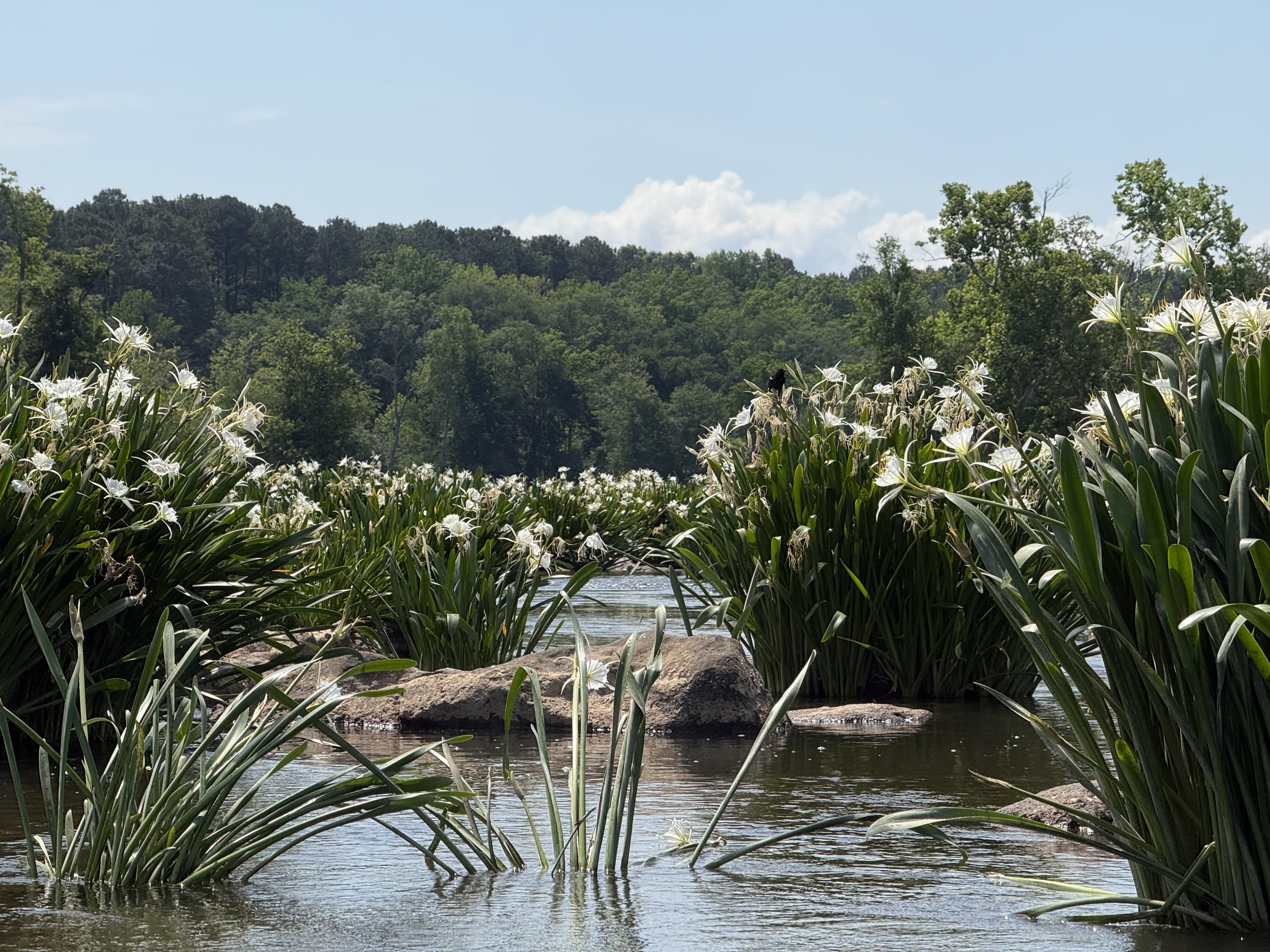
Slender, snow-white arms radiate in every direction. They stretch out from a yellow center, opening as large as my hand, rising tall above the burbling waters on green stems.
Besides calling redwing blackbirds and ospreys, it’s a quiet day on the Catawba River in South Carolina. A mile upstream, people are listening to bluegrass music, ordering ice cream, and perusing prints of these very flowers. But here, sitting low in the kayak, the lilies hide you from the bank.
Today, these flowers have their heads turned toward the late spring sunshine. Tomorrow, these blooms of Rocky Shoals Spider Lilies will be gone, replaced by new ones. This will be the only day to experience them as they are, at this moment. By June, they’ll be entirely gone.

What are Rocky Shoals Spider Lilies?
Naturalist William Bartram documented these flowers in 1773 while exploring the Savannah River near Augusta, Georgia. He wrote of them, “but nothing in vegetable nature was more pleasing than the odoriferous Pancratium fluitans, which almost alone possesses the little rocky islets which just appear above the water.”
The name partially comes from the necessary habitat (rocky river shoals) but the “spider” comes from the thin, leg-like extensions that stretch from its funnel-shaped cup. In the middle is a yellowish-green eye, but the flower itself gleams white.
Roughly four weeks each year, starting mid-May, the stems push three feet above the waters. They sprout 3 to 10 blossoms that open overnight and last a single day.
The Catawba River colony is one of the largest. An hour’s drive south from Charlotte, NC, this strand thrives inside the protected boundaries of Landsford Canal State Park.

Their rarity is because of what the spider lilies need to thrive: fast-flowing water over rocky shoals and plentiful sunshine. Over the centuries, dams have disrupted water flows and the flowers’ native habitat. Their presence signals a healthy river. There’s an effort in Columbus, GA, to restore the lily on the Chattahoochee River.
Our Morning Among the Lilies
The Catawba River pushes 1.5 miles through the park. The short distance makes arranging shuttles optional. Kayak down and walk or bike back. Though rocky, its easy flows are perfect for kids and less experienced paddlers.
We brought a recreational kayak, a kid’s kayak, an inflatable paddleboard, and a bike. The kayaks we offloaded at the northern entrance. The vehicle we deposited at the southern entrance and rode the bike back to the put-in, where we locked it around a tree. Others followed similar plans, with some locking the bike at a gate near the take-out and leaving their car at the put-in.
A tour group launched and vanished around an island. A few other individuals and families self-launched. But the waters remained uncrowded as we pushed off for our adventure, and stayed that way until the end. We had plenty of room to navigate the drops and riffles and find our own lily patch to admire.
Immediately after launching, I was glad we opted for kayaks over our canoe. Organizers had warned the drought conditions had exposed the shoals even more than normal. My kayak wedged on a rock and spun backward. Our kid turtled his over a small drop and had to step out. We made the right call keeping the skeg off the paddleboard.
Even picking what seemed like clean lines usually ended with a scrape or a bump. But we laughed it off, challenging ourselves to see who could pick the cleanest line or who would spot the lilies first.

Grasses sprang from the shoals and embankment. But slowly, as we neared the halfway point, a line of white emerged on the horizon–and not the frothing whitewater kind.
The tall lilies swallowed the river, turning the shoals into a maze. The shoreline vanished behind a wall of green and white. Birds and bees spun overhead under the brilliant spring sun. We were lucky in hitting a seasonally early peak bloom the weekend after Mother’s Day.
We found a wide rock complete with a natural harbor to stash the boats without uprooting any plants. In the middle of the Catawba River, we picnicked among the blooms. A hummingbird buzzed by after dipping into a flower. The blackbirds sang as they crossed back and forth overhead. Water murmured over small waterfalls and around boulders.
This stretch of river is one of the few places you can admire them up close. Today, only 50 populations of these endemic lilies remain and they are listed as a species of concern. Colonies are in Alabama and in Georgia.
We expected wall-to-wall kayakers. It was just us. Sitting there, you could imagine this was what William Bartram experienced back in 1773.
Touring Landsford Canal State Park
Continuing our exploration of the lily maze, we popped out on the right side of the river just in time to see the sign for the take-out. Beside the sign is a sandy beach, but the actual take-out follows a narrow channel to its right.
The trail connects both entrances and follows the Catawba River. It has a viewing platform for the lilies if you don’t wish to get out on the water.
A short walk up the path from the take-out point are the ruins that give this park its name. Centuries ago, colonists and early settlers needed a way to move goods around the shoals and Piedmont fall line. They built a narrow lock system that operated from 1820-1835.

The state park protects the remnants of these locks, a mill, and the lockkeeper’s home. They include the stone walls and empty slots for the hinges and doors. In some places, you walk on the bottom of the old canal with the stonework rising above.
We walked at the bottom of the old canal to the Davie mill ruins. A broken grinding stone lay among the walls. Through it ran tree roots—a reminder that something as fragile-looking as a tree, or a flower, is strong enough to hold onto rock, even in the middle of a river.
If You Go
- Admission to Landsford Canal State Park typically costs $6 per adult and $3 per child. For Lilyfest it was $10 per adult and $5 per child.
- Lilyfest is an annual two-day event that includes guided walks to the viewing platforms and eco-tours on the water. They run shuttles between the two entrances and overflow parking for the event.
- Want to paddle? Book the kayak eco-tours early. They sell out weeks in advance. Multiple vendors run these tours, including Catawba Riverkeeper, North Carolina Outdoor Adventures, Carolina Safari CO and Aquatic Adventures.
- A 1.5-mile trail connects the put-in and take-out. It’s a wide, relatively flat trail and has a viewing platform to see the spider lilies in season.
- The park releases Lily Watch updates in May, as peak bloom shifts slightly each season. The typical flowering season runs mid-May to mid-June.
- Landsford Canal State Park is 37 miles south of Uptown Charlotte, with around a 50-minute drive time.
- The put-in is at the northern entrance and take-out at the southern.
- If you decide to use a bike as a shuttle, know that bikes are not allowed on the hiking path. You’ll need to use the Landsford Road, which is a rural but paved backroad.


Leave a Reply