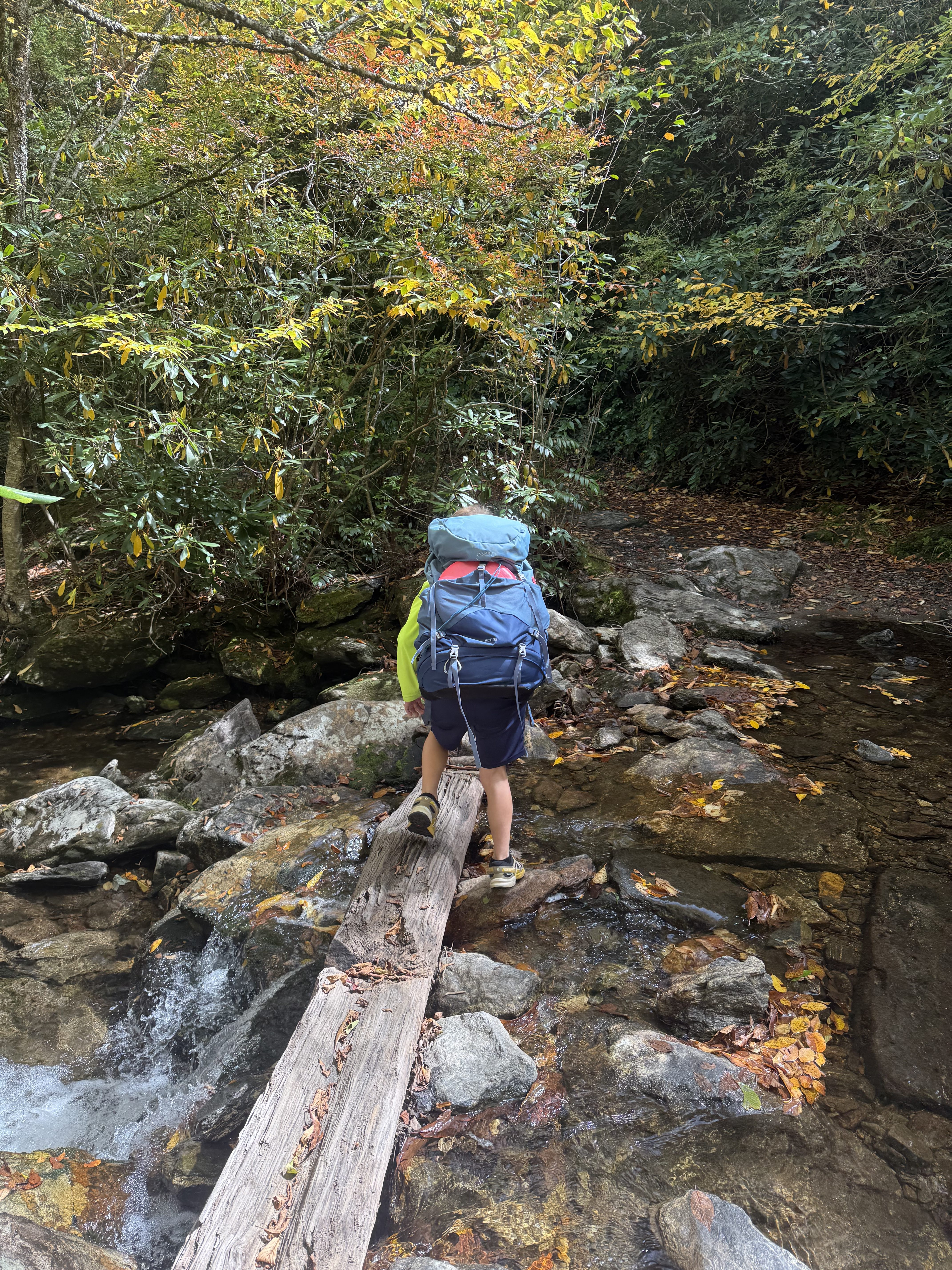
He sits arms crossed on the boulder and refuses to take another step. It’s only been 1.2 miles on a wide gravel trail. Most of it was uphill.
Two years ago, he laughed his way through a two-day, 12-mile hike without complaint. Last summer we logged eight miles a day with steep ascents in Yosemite National Park. Now he’s nine, and all that history cascades away like the water under the log bridge beside us.
Backpacking with kids is its own rollercoaster. Some trips go better than others. The parents who’ve figured things out mostly did it through trial and error, us included. After digging through online communities, a few common threads emerged.
Start Smaller Than You Think
Low-stakes early trips test the waters. We started with car-camping, as did Reddit users u/by-josh and u/mcnamebrohammer. The option to pull the plug was always there in case of weather or meltdowns or the forgotten stove.
Car camping also cuts the need to haul gear long distances. Babies need a lot of stuff that isn’t always easy to carry. I once strapped a bouncy seat to a backpack and wobbled between a smooth boulder and a steep drop-off. Lesson learned.
What qualifies as “easy” depends on you and your hikes. u/zefdo took their 20-month-old on a five-mile out-and-back backpack trip. We chose a one-mile out-and-back overnight with our then-four year-old. Both fit our families where we were.
Weather factors in, too. Babies and toddlers lack the same thermoregulation as adults, noted u/pseudoaccounto. Young bodies overheat or cool off faster. You’ll need the right layers and more rest breaks, depending on conditions. A short hike in and out may be best for everyone’s enjoyment on a hot day.
Muscular endurance is another limiter. Scrambling over rocks and logs is fun, but not mile after mile for little ones. Tired and fun quickly tips into overtired and melting down.

Rely on the Snack Economy
Food as fuel is almost universal advice across backpacking families. u/zefdo advises to bring lots of their favorite snacks. “You want their first impression good, and snacks go a long way. Don’t expect structured meals with them.”
Born to Adventure echoed this on Facebook, “Growing kids = bottomless pits. The only difference now? They pack their own and eat as needed while hiking.”
I started “trail magic” on early hikes. A special treat would appear in my hand as if from thin air–graham cookies or a Starburst. His eyes would grow big and ask, “Where’d you hide it?” As he grew older, hunting for the hidden “special” became a game down the hike.
Bring more than you need in easy to haul formats they love. This isn’t about being ultralight but about allowing kids to graze and be happy. Ours digs applesauce pouches, gummy packs, and single-wrap meat sticks.
Get the Right Hiking Gear
On our last Grandfather Mountain trip, we pulled on every packed layer possible and still shivered in our sleeping bags. Checking the forecast is always smart. Underestimating the conditions is not. If it says 40% chance of rain, pack for rain.
Multiple other parents agree. Proper gear makes everyone comfortable. Werner highlights his discovery of a Junior Ranger vest as a snack carrier. It was both functional and a hit with the kid.
Gear adds to the buy-in. Reddit u/graywoman7 points out how, “At 3-4 years old they’re old enough to have the sense of accomplishment that comes with carrying something important. Having that ‘job’ will help them want to keep going when they’re tired.”
It’s a sentiment reddit u/Total_Fail_6994 agrees with, talking about outfitting the learning hiker with a small pack carrying their clothes and snacks. Our kid beamed with pride the first time he tried on his “grownup” backpack.
The challenge lies finding the line between the right gear and overpacking. In the toddler era, especially: How many diapers and wipes are too many? Do you need an extra set of pajamas or sleeping clothes? Soap, hand sanitizer, or both? The gear equation needs to be worked out trip by trip.

Let Kids Lead
It’s hard to slow down when you’re used to covering miles in half a day. Philip Werner learned this firsthand hiking with his four-year-old grandson. “Roar up the trail for five minutes and then climb a tree for five minutes, roar up the trail for five minutes and then gripe for five minutes. Progress was SLOW,” he wrote on Section Hiker.
Slow is the point. Allow the salamanders on the trail or a cool rock to capture kids’ attention. Embrace the discoveries as their pathway to learning to enjoy being outdoors.
One strategy u/zefdo uses is letting their toddler show them the way. “A walking stick as a magic wand makes it super fun for them.” Pretending games was another tactic parents used.
Remember, kids lack a sense of distance or time, especially our ADHD one. Twenty steps can feel like he’s come half a mile.
Pushing the mileage to achieve a goal leads to meltdowns, like our kid sitting on a rock. We wanted to reach the old-growth forest on a four-mile hike. Our kid wasn’t having any of it.
Learn From Every Trip
After nearly 1,000 feet of climb, he parked himself on the boulder and declared enough. We made two mistakes on Macron Bald that day: we pushed the pace and forgot the snacks. All we carried was water and popcorn.
Backpacking with kids is always about the balance between learning to be uncomfortable and listening. That day, we turned around.
In more time than you think, they’ll be outhiking you.


Leave a Reply